
Getting started on your journey of living and working abroad is a daunting task on its own, and trying to coordinate as a couple can feel even more monumental. Before my significant other and I began, I immersed myself in scouring the internet for advice and stories of others who had gone before me. The myriad of personal accounts and guidance I found really helped me make some important decisions, and shone a light on something that I knew very little about. Thus, I want to share my experience for those couples who are wondering how it works or are starting their own journey in this process.

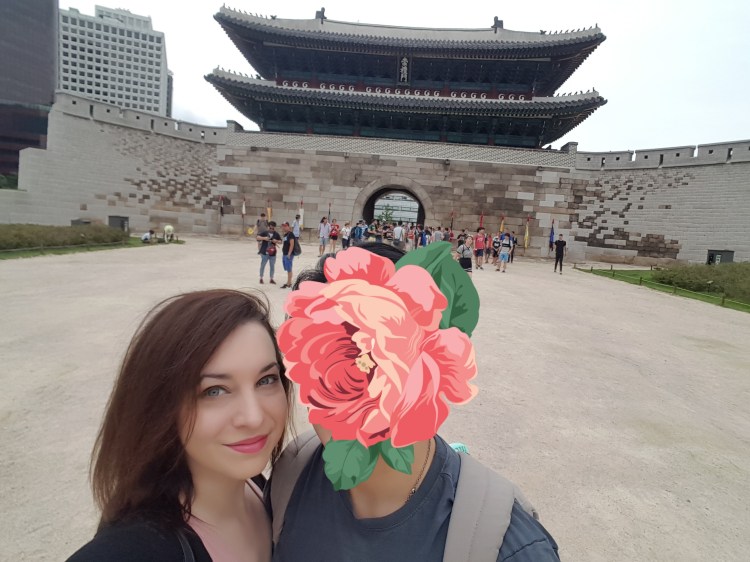
Being able to travel and work abroad together was something that, I think, brought us closer together as a unit. Not to mention we were able to share an awesome adventure; We were lucky enough to travel while working only about 27-30 hours a week at most (really!), and save a little money as well. Maneuvering through the complexity of living in another country was a little less stressful having a partner at my side, and exploring the culture and nuances of living in South Korea was fun having my boyfriend to share it with.
Although sometimes my embarrassing moments, that would be forever forgotten to the annals of history if I were solo, were witnessed by my boyfriend (so many face-palm inducing instances). I am still hearing about the time we had to search for a toilet late at night in Gangneung, and I was given the key to the most terrifying and horrific hole in the ground…. while outside my boyfriend was being propositioned by an old woman…we were obviously in a seedy part of town. Hilarious escapades aside, most of our life abroad felt like an amusing and enjoyable exploit.
We ended up residing in Seoul, South Korea for a year working with Chungdahm Learning, and I will go in depth about the process for them specifically – as well as general information about how to teach abroad as a couple.

How to get started.
Find a company that will be willing to work with you as a couple, and try their best to place you in the same workplace or in nearby workplaces. The reality is that you will most likely not work in the same location, but with luck you will be close by. This is what happened for us, and two other couples we met in Korea after moving there.
We looked at multiple countries and opportunities, and applied to a few (Japan, South Korea, and China). The destination was not definite, we remained open and I believe that mindset is imperative to finding success in this venture. A lot of research was involved, and we searched countless forums and blogs to see what different people’s experiences were like with different opportunities. We ended up going for Chungdahm Learning in South Korea through their recruiting agency, Aclipse, because they were the most responsive and our recruiter was incredibly helpful as well as an awesome advocate for us as a couple.
It is important to note that regardless what company you choose, they will evaluate you as an individual first. You must both be qualified and do well on your interviews.
Interview Process
You will typically submit your resume first, and once that is accepted you will move on to the next stage.
The interview process with Aclipse was very streamlined, and for more detailed instruction you can read about it on their website. Common interviews for most companies will involve you having a “mock class” with someone pretending to be a student to evaluate your basic skills.
For Aclipse/Chungdahm, you will also create a video introducing yourself. My own video embarrasses me to this day; it can be painfully awkward showing your personality in this medium without a lot of preparation (I ended up having to do it twice). My boyfriend, on the other hand, did so well with his that he became a popular candidate for Chungdahm! It’s important to be comfortable and relaxed, but also show an upbeat personality – keep in mind: they are looking for how you can present yourself in front of a class. They want a teacher who can take command of a classroom and engage the students.
Something to consider
To be more advantageous candidates, my boyfriend and I obtained a TEFL (Teaching English as a Foreign Language) Certificate. This is an easy course that provides basic skills in teaching methodology and lesson planning, and can all be done online.
There are other certificates available, and depending on the time and money you are willing to invest, they are great additions to your resume. TESOL, TEFL, and CELTA are all certifications for teaching English as a foreign language.
Visas – Oh the struggle
Once you are accepted, you will begin the arduous ordeal of obtaining your work visa. For South Korea it involves:
- 1 apostilled photocopy of your Bachelor’s degree
- 1 apostilled criminal background check (federally issued)
- 2 passport photos
- and a health statement (provided by your employer)
The apostilling process takes time, so I would start as early as possible. Once these are completed, you will have to visit your local South Korean embassy to apply for the visa. This also takes time, and because of this my boyfriend and I actually ended up having to take different flights on different days to Korea.
First Week Abroad
This is where the various companies/schools diverge – for some teaching jobs, you might receive no training at all and start immediately. For others, like Chungdahm, you will have a training period.
Chungdahm Training Week is stressful for many who go through it. You have a week to learn, prepare, and prove your teaching skills to an assigned trainer. This is done within a small group of three to four other trainees, and it can be a lot to learn in a short amount of time. My advice is to do your homework, be confident (regardless if you make a small mistake), and get some sleep! This is something that you can fail, and some applicants do not pass because they either didn’t familiarize themselves enough with the material/tablet or were too nervous to teach in front of the classroom.
My experience was lovely, the training center was at the location I was going to work at (Songpa branch), and my trainer was one of the teachers at my branch. Although it was a long week, I felt supported by my trainer and my group, and prepared to start teaching with the curriculum by the end of it. No one wants you to fail, they will do their best to help you pass. Ultimately it’s up to your own dedication!
Starting Life Abroad – Finding Housing
Once you’ve made it through the whole gamut, life abroad really begins and you’ll need a place to sleep! Some schools will provide you with housing they have already set aside, while others will provide you with a stipend for housing. This is important in Korea, as renting an apartment works very differently than renting an apartment in the US. You will have to put down a large sum (given to you by your workplace) through the wolse system (which involves a deposit of 5-10 million won or more), and then pay rent each month. This large sum is actually returned to you (or the company/school) once you complete your rental agreement, and is intended for the landlord to invest (and make some extra money) while you are living there.
In my experience, Chungdahm provided a realtor to show different apartments near my place of work. We ended up living close to Lotte Tower in the Songpa-gu neighborhood of Seoul in a sizeable (for Korea) studio apartment. We really wanted a separated shower, and were fortunate enough to find one! Most bathrooms in Korea have just the shower head attached to the wall in an open space with the toilet and sink, and a drain in the floor. As a couple, our monthly rent was incredibly cheap (we each paid about 400,000 won a month which equates to about $400 a month).
If you are frugal and organized with the money you earn, you can actually save a decent amount of money in a year. With the money we saved we were able to travel through France and Italy for 2 1/2 weeks, and have some seed money to start our lives in California when we got back.
Still wondering if it’s worth it?
Backpacking and vacationing throughout the world is fun, but spending 6 or more months in a different country is incredibly more valuable. Living abroad affords you to chance to fully immerse yourself in a culture, challenge yourself daily, and I believe it’s something everyone should experience at least once in their lives if possible. And being able to do it together with your partner will deepen your relationship, and create lasting memories for you both.
 Clumsy Adventurer